Who is buried in Montparnasse Cemetery
Planning your afternoon in Montparnasse?The tower is shut, but the Catacombs entrance is a short walk away at Denfert-Rochereau, and the old painters' quarter is best seen with someone who knows its stories. These are the tours you can book.
Compare the toursThe cemetery in brief
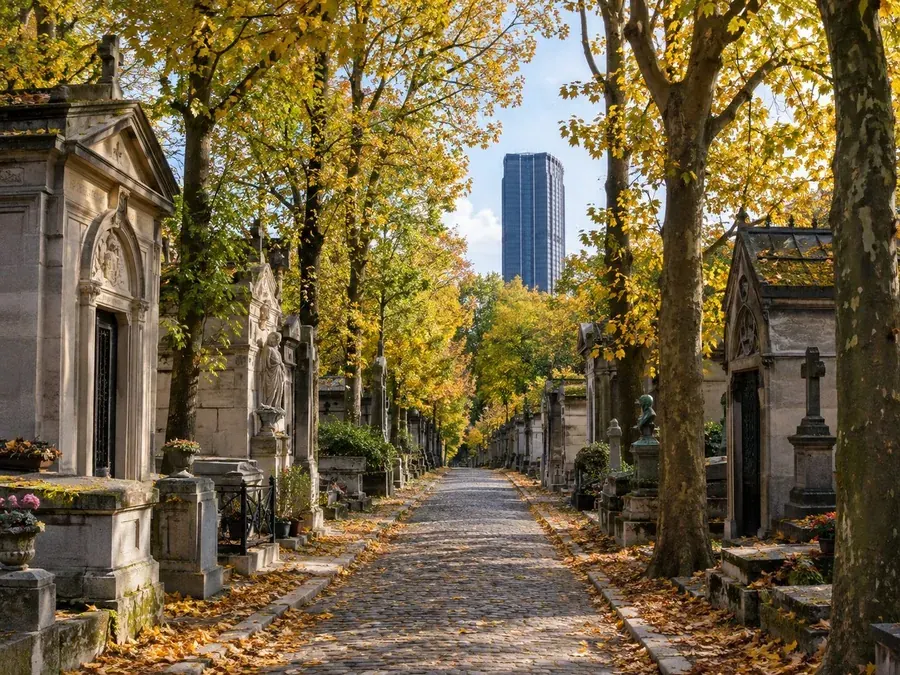
Montparnasse Cemetery is the second-largest cemetery inside Paris, after Père-Lachaise. It has more than 35,000 plots and about 1,200 trees. From the old observatory on the 56th floor of the tower it was the long green rectangle right below, between the rooftops; I used to point out my own street beyond it. The tower’s story is on the Tour Montparnasse in figures.
It is open every day. It opens at 8:00 on weekdays, 8:30 on Saturdays and 9:00 on Sundays and public holidays, and closes at 18:00 from mid-March to early November and at 17:30 in winter. The last entry is about 15 minutes before closing. Check the City of Paris cemetery page before you go. No ticket is needed, which is why I call it the best-value hour in the district.
The graves people come for
- Jean-Paul Sartre and Simone de Beauvoir, in one shared grave.
- Charles Baudelaire and Samuel Beckett.
- Serge Gainsbourg.
- Marguerite Duras and Susan Sontag.
- Alfred Dreyfus.
- Julio Cortázar; a tour listing describes his grave covered in métro tickets and hopscotch drawings left by readers.
- Porfirio Díaz.
- Jacques Demy and Agnès Varda, together in the same grave. She lived a short walk away on rue Daguerre.
- Jean Seberg (division 13), Constantin Brancusi (division 18), Guy de Maupassant (division 26) and Man Ray.
The famous graves are spread across the whole site, so note the division numbers above before you set off.
A quiet visit
This is a working cemetery, not a monument. I keep my voice down, step aside for anyone visiting their own family, and leave nothing but a métro ticket or a flower where others have done the same.
With a guide
You do not need a guide to find the famous graves, but a guide adds the stories. The two-cemetery tour sold here starts at 3 boulevard Edgar-Quinet and spends about 1 h 15 at Montparnasse, among Porfirio Díaz, Cortázar, Sartre and Beauvoir, Gainsbourg, Baudelaire and Beckett. Then the group takes the métro together, one ticket each included, to Père-Lachaise. In total it lasts about 3 h 30 to 4 h, in English, French or Spanish, with at most 8 people. It involves a lot of walking on cobbles and slopes and is not suitable for wheelchairs. It is the dearest of the walks sold here, and it has only one review so far (5 stars, no text), so judge it on what the listing promises. The honest assessment is on the two-cemetery tour, reviewed. Full refund if you cancel up to 24 hours ahead.
Varda, from her street to her grave
The Agnès Varda cinema walk ends here, at the grave she shares with Jacques Demy, after rue Daguerre and the filming locations of Cléo de 5 à 7. It lasts 2 h, meets at 77 avenue du Maine and rates 5.0 on only 3 reviews. It is reviewed on the Agnès Varda walk, reviewed. Full refund if you cancel up to 24 hours ahead.
Come in the morning, see the cemetery, then walk to the Catacombs entrance at Denfert-Rochereau for an afternoon slot. Rue Froidevaux runs along the cemetery wall.
Frequently asked questions
Who is buried in Montparnasse Cemetery?
Among others: Sartre and Beauvoir, Baudelaire, Beckett, Gainsbourg, Duras, Sontag, Dreyfus, Cortázar, Porfirio Díaz, Man Ray, Brancusi, Maupassant, Jean Seberg, and Jacques Demy with Agnès Varda.
Do you need a ticket for Montparnasse Cemetery?
No. No ticket is needed and it is open every day, from 8:00 on weekdays (9:00 on Sundays) until 17:30 or 18:00 depending on the season.
How far is the cemetery from the Catacombs?
A short walk. Rue Froidevaux runs along the cemetery wall towards place Denfert-Rochereau; the Catacombs are covered on visiting the Catacombs.
Is Montparnasse Cemetery bigger than Père-Lachaise?
No. At about 19 ha it is the second-largest cemetery inside Paris; Père-Lachaise is larger.
Which Montparnasse artists are buried there?
Man Ray, among others, and Sartre, Beauvoir and Beckett, who came later. The cafés where that generation met are on Montparnasse in the 1920s.