Montparnasse in the 1920s
Planning your afternoon in Montparnasse?The tower is shut, but the Catacombs entrance is a short walk away at Denfert-Rochereau, and the old painters' quarter is best seen with someone who knows its stories. These are the tours you can book.
Compare the toursWhy here
The district’s golden age ran from about 1910 to the 1930s. After the war came the Americans: between 1921 and 1924 the American population of Paris rose from about 6,000 to 30,000, and many of them ended up in Montparnasse. The French call the decade les Années folles. The streets around it are described on Montparnasse district, street by street.
The cafés, one by one
- La Closerie des Lilas, 171 boulevard du Montparnasse, founded in 1847. Hemingway wrote much of The Sun Also Rises there, and his name is on a brass plate at the bar.
- Le Dôme, 1898, at the Vavin crossroads.
- La Rotonde, 1911, at the same crossroads.
- Le Select, opened in the 1920s.
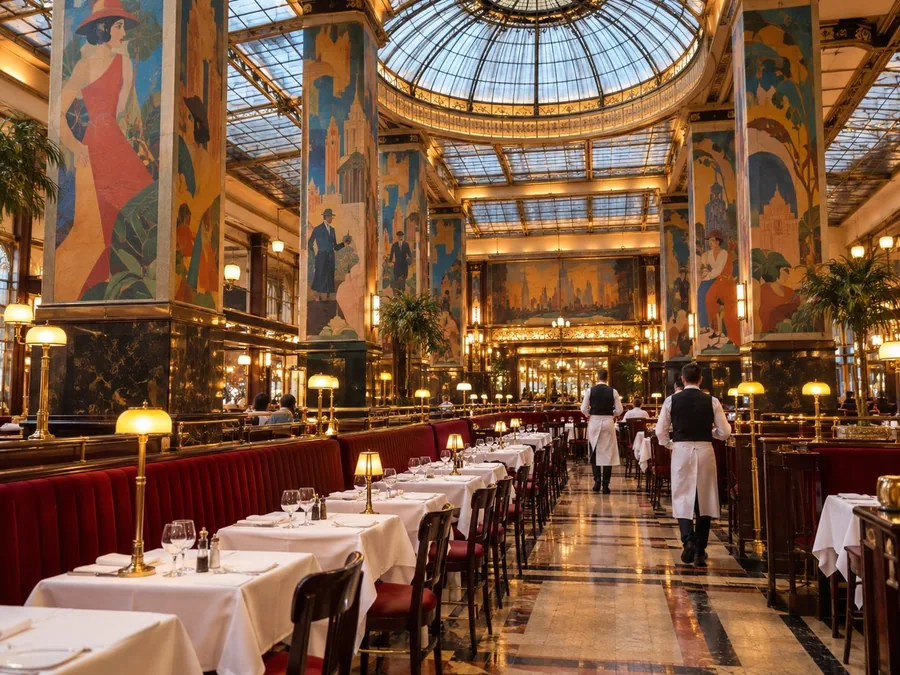
- La Coupole, 1927, the Art Deco brasserie with painted square pillars and long rows of white tablecloths.
I still take visitors to La Coupole for lunch, mostly for the room. Sit at the Closerie bar if you want the Hemingway plate; the Vavin crossroads is where you see all four of the others at once.
The artists and writers
The painters were Picasso, Modigliani, Chagall, Soutine and Foujita, who arrived in 1913. Among the writers were Hemingway, Fitzgerald and Joyce. Man Ray photographed the scene, and Kiki de Montparnasse was its best-known model. Beckett, Sartre and Beauvoir, and Giacometti came later and kept the district’s reputation going. Several of them never left: Man Ray, Beckett, Sartre and Beauvoir are buried in Montparnasse Cemetery.
La Ruche, the artists’ residence on passage de Dantzig founded in 1902, housed Chagall, Soutine and Modigliani at one time or another. It is still a working residence; look through the gate and move on.
Which walk to take
Three small walks sold here cover this period, each with very few reviews. None of them is a safe bet on numbers alone; judge them on what the listing promises.
The 1920s Montparnasse walk is the broadest. It lasts 2 h (the listing says it can run to 3), in English or Russian, and starts at 27 rue de Fleurus by the Luxembourg Gardens. The listed stops are the Luxembourg Gardens, La Rotonde, La Coupole and La Closerie des Lilas, ending at Gare Montparnasse. The stories include where Hemingway’s boxing match took place, Fitzgerald and Zelda, where surrealism began, Kiki and the artists she sat for, Foujita, Rodin and Camille Claudel. It rates 5.0 on 6 reviews. Kathleen, from the United Kingdom, found the guide “very enthusiastic and informed”. More on the 1920s walk, reviewed. Full refund if you cancel up to 24 hours ahead.
The Hemingway walk with an actor-guide is more theatre than history lecture: a professional actor plays Hemingway for 1 h 30, in English or French, for groups of 15 or fewer. It meets at 69 boulevard Saint-Michel and walks the cafés, streets and parks of this side of the Left Bank, with Fitzgerald, Gertrude Stein and Ezra Pound. It rates 4.6 on 6 reviews. David, from the United Kingdom, wrote that the guide “really brought the scenes to life”. Jim, also from the United Kingdom, gave it four stars: the tour was excellent, but nobody greeted them at the meeting point and they had to look for the guide. The full review is on the Hemingway walk, reviewed. Full refund if you cancel up to 24 hours ahead.
The Agnès Varda walk belongs to a later Montparnasse, from the 1950s onwards: rue Daguerre, her films and her grave. It rates 5.0 on 3 reviews and suits film lovers more than readers of Hemingway.
If you only have a morning, walk it yourself: the Closerie des Lilas, then west along the boulevard to the Vavin crossroads, then down to the cemetery gate on boulevard Edgar-Quinet.
Frequently asked questions
Where did Hemingway go in Montparnasse?
Above all to La Closerie des Lilas, where he wrote much of The Sun Also Rises; his name is on a brass plate at the bar. The actor-guide walk follows him around the district.
Which Montparnasse cafés date from the 1920s?
Le Select opened in the 1920s and La Coupole in 1927. Le Dôme (1898), La Rotonde (1911) and the Closerie des Lilas (1847) are older.
Who was Kiki de Montparnasse?
A model at the centre of the 1920s scene, closely linked to the photographer Man Ray. The 1920s walk covers her and the artists she sat for.
Which 1920s walking tour should I take?
The 1920s walk for the broad story, the actor-guide walk if you mainly want Hemingway. All three small walks are compared on Montparnasse tours, compared, and the Varda walk on its own review page.